
The Old, Discredited Left in New Clothes
America’s democratic socialists aren’t Scandinavian. They’re resurrecting a flawed paradigm buried by stagflation — and the “neoliberalism” they think they’re overthrowing was never really a thing.

American socialism is having a moment. In November 2025, Zohran Mamdani won New York‘s mayoral race. A day later, on the opposite coast, Katie Wilson took Seattle, albeit by the thinnest mayoral margin since 1906. This spring, democratic-socialist candidates advanced to the November ballot in Washington, D.C. and Los Angeles, and in June, Mamdani-endorsed challengers swept a round of New York primaries, unseating incumbents who had held their seats for decades. A Fox News poll in March found a record 38 percent of Americans saying it would be good for the country to move away from capitalism and toward socialism — up from 18 percent in 2010 and running especially high among younger Democrats.
Perhaps this phenomenon is not all that remarkable, though. Consider that in the dying days of the USSR, polls found a comparable share of Soviet citizens still preferred some form of socialism to American-style capitalism. That young Americans are now about as keen on socialism as the people who watched it collapse may say less about a coming revolution than about the enduring appeal of the idea.
But “socialism” — “democratic socialism,” even — is a slippery word. What most American politicians who claim the label mean by it bears little resemblance to how the system actually works in the countries like Sweden they hold up as models.
Don’t tell these self-styled democratic socialists and their supporters this dirty little secret though, for they are too busy celebrating the death of the post–Cold War center-left. Their jeremiad is that the coalition Bill Clinton assembled and Tony Blair exported — the “neoliberal” Third Way of free trade, balanced budgets, welfare reform, and deference to markets — has collapsed under the weight of its own broken promises and socialism is rushing into the vacuum. To hear America’s rising “socialists” tell it, the era of triangulation and coddling the rich is over and is making way for true progressivism only they can deliver.
This post explains how American democratic socialism circa 2026 is neither democratic nor socialist; the version of social democracy that Sanders and Ocasio-Cortez and Mamdani and Wilson claim they’re delivering is actually something much older and more distinctly American than Swedish. It’s the populist-statist regime that ran from the Progressives through Richard Nixon, the one stagflation discredited in the 1970s.
This post also takes issue with another claim that’s become ascendant, the idea that the Sanderistas are burying a neoliberal order. It turns out that this never really existed. What actually animated economic policymaking after the Cold War, as I argue in History’s Most Revolutionary Innovation, was a technocratic, evidence-based, pie-growing consensus that solved market failures, disciplined itself with cost-benefit analysis, and built the digital economy and the runway for AI. And we dismiss the real, lasting achievements of the moderate center — to which the center-left was pivotal — at our peril.
I address each of these myths—the neoliberal order that never was, the socialism that isn’t Scandinavian, and the democracy that isn’t very democratic—in reverse order.
Part I: There was never any neoliberalism to kill
Let’s start with the corpse that supposedly nobody is mourning. If “neoliberalism” means what its critics say it means — the government as a minimalist referee that protects property, enforces contracts, and otherwise steps back and trusts markets to allocate everything — then it never commanded a consensus in Washington, and it was never actually implemented. What ran the United States from Carter to the end of the Obama administration was not minimalist-referee neoliberalism. It was a technocratic, evidence-based, bipartisan paradigm I call the Creative Destruction Paradigm, and its whole purpose was to grow the pie by solving the market failures that markets, left alone, can’t solve themselves.
To be sure, on the surface, the post-1970s record reads like a neoliberal victory lap. Carter deregulated airlines, rail, and trucking. Reagan cut top marginal tax rates and loosened financial regulation. Washington privatized where it could, preached fiscal restraint at home, pushed austerity abroad, signed NAFTA, and built the WTO.
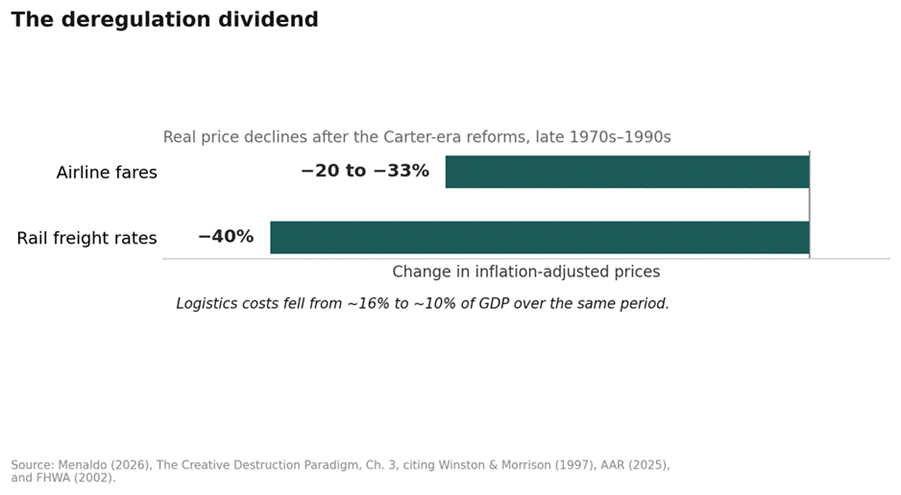
Figure 1. The deregulation reforms of the Carter–Reagan era cut real prices for consumers and slashed the cost of moving goods through the economy — gains that compounded for decades.
Take Figure 1, which reveals that after deregulation, inflation-adjusted rail freight rates fell by about 40 percent and airline fares collapsed too, albeit by less. The logistical cost of moving goods through the American economy dropped from around 16 percent of GDP toward 10 — the hidden plumbing that made just-in-time supply chains, e-commerce, and the data economy possible. A clear win for neo-liberalism.
But strip away the free-market vocabulary and look at the reforms that built the digital economy that has helped make Americans the richest inhabitants of the liberal democratic world, and you find a government creatively solving the market failures that were keeping private capital on the sidelines. The federal government spoke out of both sides of its mouth: it lionized fiscal restraint and deregulation while quietly spending money, time, and attention to act as the strategic conductor of an orchestra of universities, firms, agencies, and investors to build the digital economy together.
Consider that the first electronic computers were built to break enemy codes during World War II and, soon after, to run the calculations for the hydrogen bomb. Radar, the transistor, the laser, and the integrated circuit came out of a public-private system — Bell Labs, Fairchild, and university laboratories did the inventing, but federal research budgets, defense procurement, and guaranteed military demand underwrote the risk. Cold War air-defense systems pioneered the real-time computing and networking the internet would later inherit; the race to the moon pulled whole supply chains of microelectronics into being; and DARPA, the Pentagon’s blue-sky shop, funded the packet-switched network that became the internet.
Basic research is the textbook good a market underprovides — the payoff is enormous, diffuse, and impossible for any single firm to capture — so for half a century Washington supplied it, and the entire edifice of Silicon Valley was raised on that publicly funded foundation.
Having paid for the science, the government then built the machinery that let private firms own it. Property rights to ideas are not a fact of nature; they are constructed and enforced by the state, and Washington supplied the whole apparatus — the patent system, the examiners, and eventually a specialized appeals court built to make those patents stick — so that a discovery could be owned, licensed, and borrowed against rather than copied the moment it appeared.
Similarly, federal telecommunications policy built a market where none had previously existed: working with auction theorists, the FCC ran “simultaneous multiple-round” spectrum auctions that turned slices of the electromagnetic spectrum into clear, tradeable property rights, moving the “beachfront” airwaves from television broadcasters to the carriers who would build 4G. There was no market until the state designed one. And when Verizon won the 700 MHz “C-Block” in 2008, the FCC wrote openness into the deal as a condition of sale — the winner had to let any device and any app run on its network. That single auction rule is much of why your phone runs whatever software you want instead of a carrier-approved walled garden.
The same hand was at work all the way down. A “shot clock” kept local zoning boards from strangling cell-tower construction with endless delays. The Act forced incumbents to lease their legacy copper to competitors, then deliberately exempted new fiber — a credible promise not to make firms share the upside of their riskiest bets, which is exactly what freed the capital to build them. Around 150 new carriers entered within three years, connection prices fell by a fifth, the E-rate program wired 98 percent of American public schools to the internet by 2000, and the whole reform pulled something like $1.4 trillion of private investment into the network the data economy now runs on.
Technical standards are another example of the federal government making a difference. Every smartphone is an assembly of parts from rival firms, arrayed up and down a supply chain, that interlock only because they were built to common standards — IEEE for Wi-Fi, 3GPP for the cellular air interface, the USB consortium for the port. But writing those standards means sitting fierce competitors down at the same table to agree on a shared design, which is very close to the one thing antitrust law exists to forbid, because it looks like collusion under the Sherman Act. Left to the market, the process would have seized up: firms afraid of being sued for cooperating, afraid of backing the standard that loses out, afraid that a rival would conceal an essential patent and spring it once everyone was locked in.
So, Washington, D.C. built the table and policed it. Congress carved out the antitrust safe harbors — the National Cooperative Research Act in 1984, extended to standards bodies two decades later — so that sitting down with your competitors to write a standard wouldn’t land you in court. NIST, the federal standards agency, played neutral broker, supplying the metrology, the performance benchmarks, and the testbeds where rival firms could prove out their technology in a pre-competitive zone, defusing the paralysis that comes from fear of betting on a dead end. And when a firm tried to cheat the process — as Dell did, certifying it held no relevant patents during a standards fight, then trying to enforce a hidden one after the industry had committed — the FTC stepped in and turned the standards bodies’ private disclosure rules into enforceable public obligations. The reward was a smartphone that stitches together dozens of standards on fair and reasonable terms — and a Fourth Industrial Revolution built on top of it. None of that is refereeing. It’s engineering.
Part II: The Scandinavian mirage
Mamdani and Wilson and the broader Democratic Socialists of America point, as Bernie Sanders pointed before them, to Scandinavia. We just want what Denmark has. We want what Sweden has. It’s a seductive picture: a humane, prosperous, low-inequality society that proves you can tax the rich, fund a lavish welfare state, and still thrive.
The picture is almost exactly backwards. Sweden isn’t a refutation of capitalism. It’s one of the most capitalist countries on earth, with a big welfare state bolted onto the back end.
Look at what Sweden actually does. It has one of the highest rates of billionaires per capita in the world — Forbes counted 43 in 2024, roughly four per million people, double the American rate. It allocates goods and services through prices, protects strong property rights, and lets its global champions — IKEA, Spotify, Ericsson — earn fat profits. It’s not a command economy: private enterprise dominates, though the state still owns a few large firms outright, like the miner LKAB and the utility Vattenfall. When its banks collapsed in the early 1990s, Sweden did rescue them — but it did it the hard way, guaranteeing the system while wiping out shareholders and forcing the losses onto the owners. Sweden made shareholders eat the losses as the price of rescue — closer to the opposite of the 2008 American reflex, which propped up institutions and largely spared their owners. It let Saab Automobile go bankrupt, and Volvo Cars ended up Chinese-owned, bought by Geely. And for decades it welcomed foreign capital with almost no strings, screening sensitive deals only since 2023.
The tax system is where the left’s image of Sweden really falls apart. Sweden has no wealth tax — a Social Democratic-led government abolished the inheritance and gift taxes in 2004–05, and a center-right government abolished the wealth tax in 2007, after watching its rich, including IKEA’s founder, decamp for lower-tax countries. Its corporate rate is 20.6 percent, cut from 28 over fifteen years by governments of the left and the right. And it pays for its welfare state not by squeezing the rich but by taxing everyone — a 25 percent value-added tax and heavy levies on ordinary wages.
The numbers are the opposite of what Americans assume. The total tax burden on an average worker — the “tax wedge” — is higher in every Scandinavian country than in the United States, and in Sweden it’s dramatically higher.
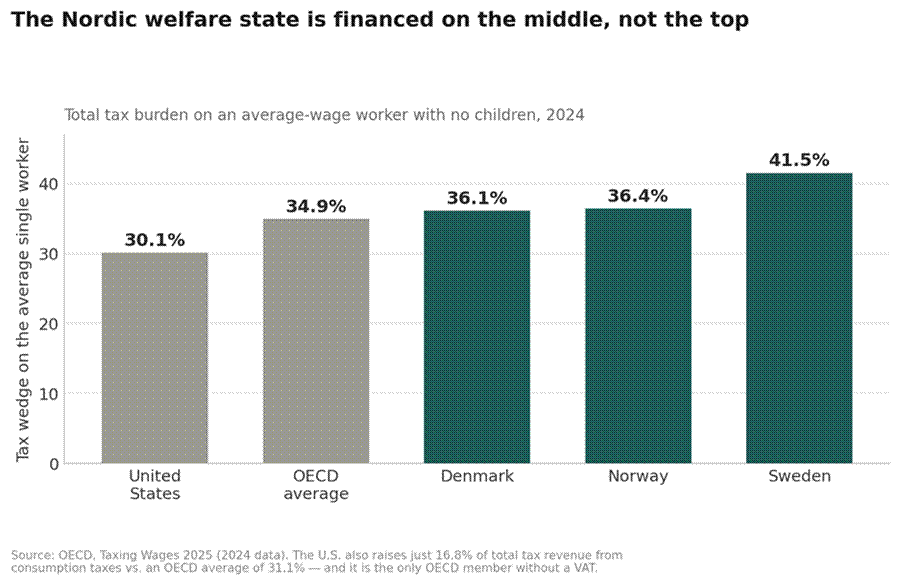
Figure 2. The Nordic welfare state is financed by broad taxes on ordinary wages and consumption, not by levies on a narrow top. The average Swedish worker hands over 41.5% of the cost of their labor to the state, versus 30.1% for the average American. The U.S. is also the only OECD member without a VAT.
So if the Nordics tax their middle class harder than we do, where does their famous equality come from? Two places, and neither is the one American socialists imagine. The first is that their market incomes — what people earn before a cent of tax or transfer — are far more equal than ours to begin with. The second is that taxes and transfers then redistribute somewhat more on top. Mogstad, Salvanes and Torsvik put numbers on it: in the Nordics, taxes and transfers cut the Gini coefficient by about 12 points, versus 8 to 10 in the United States. But in their decomposition, that back-end redistribution explains only about a third of the gap between us. The bigger share is that the Nordic market distribution is already about as equal as American income is after all our taxes and transfers.
Here is where the American left thinks it has found its mandate — and misreads it completely. Yes, that more-equal market distribution comes from compressing wages before taxes, through coordinated, economy-wide bargaining and powerful unions. The socialists hear “predistribution” and “strong unions” and assume Scandinavia is vindicating their program. But look at the constraint the Nordic system accepts. Wages are set by sectoral bargaining in which the export sector leads — the wage norm is whatever firms like Volvo and Ericsson can pay and still win business against Germany and South Korea. The unions hold the line on raises that would price their own employers out of world markets, because they know a wage the traded sector can’t bear is a wage that destroys their members’ jobs. The compression is real, but it is tethered to productivity and to global competitiveness. It grows the pie even as it shares it more evenly.
And the Nordic worker accepts that discipline because the bargain comes with generous social insurance: a world-class system of education, training, health care, and income support — all of it financed by the thriving capitalist economy that the wage restraint keeps competitive. That is the deal. Wage moderation and openness to creative destruction on one side; security and opportunity on the other; growth underwriting both.
The American socialists want the equality without the discipline that produces it — pay floors set by political demand rather than by what the traded sector can bear, rent freezes and price caps that override the market by fiat, none of it tethered to whether the pie is still growing.
When the Swedish left pushed hardest in exactly this direction — the 1980s wage-earner funds meant to hand corporate ownership to union-controlled funds (the very scheme Bernie Sanders would propose importing to America in 2020), make-work public jobs, public spending swelling toward 70 percent of GDP — it triggered capital flight and a furious business backlash and when a financial crisis hit in the early 1990s and ushered in stagflation that immiserated rich and poor Swedes alike, Stockholm dismantled this socialist experiment and turned decisively toward markets. The lesson Sweden learned the hard way is the one the Democratic Socialists of America (DSA) hasn’t: redistribution works only when capitalism produces a big enough pie to spread around more equally.
Indeed, consider that the Nordics are as productive per hour worked as the United States. Denmark and Norway produce more GDP per hour than America — Norway’s number is flattered by petroleum — and Sweden is essentially tied. The reason American GDP per capita runs higher: Americans work more hours, over 200 more a year, not that we’re more productive.
In short, the Scandinavian model doesn’t trade prosperity for equality. It gets both, on the back of competitive, innovative, productive markets. The Nordics have no statutory minimum wage — wage floors come from bargaining, not legislation. Denmark’s celebrated “flexicurity” model gives employers unusual freedom to hire and dismiss by European standards, paired with generous income support and retraining. And they invest in innovation at a level few countries on earth match.
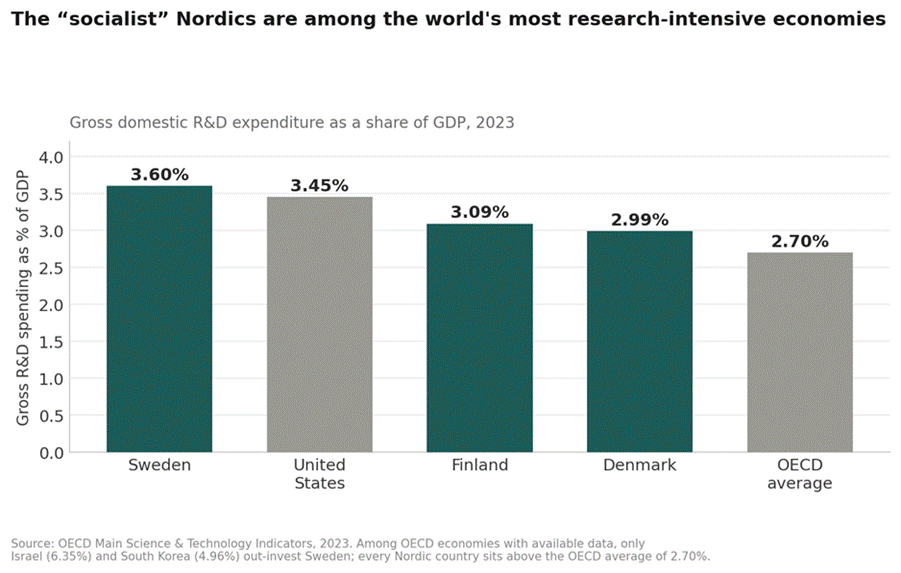
Figure 3. Sweden out-invests the United States in R&D as a share of GDP, and Finland and Denmark sit above the OECD average too. Among OECD economies with available data, only Israel and South Korea spend more than Sweden. The “socialist” utopias are innovation machines.
So, the American democratic socialists aren’t asking for Sweden. They’re asking for Nordic outcomes through anti-Nordic means. They want the safety net without the growth engine that pays for it, the equality without the competitive markets and coordinated wage-setting that produce most of it, and the generous transfers without the broad, regressive tax base that finances them. Hand the DSA Sweden’s actual policy toolkit — abolish the wealth tax, scrap the estate tax, cut the corporate rate, install a 25 percent national sales tax, ditch the minimum wage, let iconic firms fail and be sold to foreign buyers — and they’d revolt against nearly every line of it!
Part III: The thing that’s actually rising
If it isn’t Scandinavia, what is it that America’s ascendant social democrats want? It’s a populist-statist paradigm — the regime the Creative Destruction Paradigm replaced, the one that ran from the Progressives through Richard Nixon and that stagflation discredited in the 1970s.
Populist statism runs on a recognizable toolbox, and it isn’t, despite the rhetoric, mainly about correcting market failures. It’s about cementing political coalitions through rent creation and redistribution — trading long-run growth for immediate, targeted, excludable gains to favored constituencies. The devices recur across a century: price-distorting controls on food, fuel, housing, and utilities; credit and financial repression that steers cheap capital to the connected; public hiring as patronage; make-work and white-elephant spending; and trade protection for politically useful incumbents.
The signature move is rhetorical — attack “elites” and “the corrupt establishment” on behalf of “the little guy” — even as the policies disadvantage diffuse entrepreneurs, workers, and consumers in favor of concentrated, organized interests.
To be sure, these episodes differed enormously in purpose and context — Progressives, New Dealers, wartime mobilizers, Great Society liberals, and Nixonian price controllers were not one coalition or one ideology. But they reached again and again for the same tools. The Progressives gave us railroad rate controls and occupational-licensing regimes that fenced out competitors in the name of protecting consumers. Wilson imposed wartime price controls. FDR’s New Deal entrenched the whole approach: the National Industrial Recovery Act’s “codes of fair competition,” the Agricultural Adjustment Act’s price floors, the Wagner Act, Regulation Q’s caps on deposit rates, and the WPA and CCC’s public employment on an unprecedented scale. Then a second wave: LBJ’s minimum-wage expansion and managed farm pricing, and Nixon’s literal 90-day freeze on all wages and prices — before the model collapsed into the stagflation that discredited it.
Now set Mamdani’s and Wilson’s platforms beside that list. Mamdani’s rent freeze: a price control on housing. Government-run grocery stores — floated in both New York and Seattle: public provision aimed at capping consumer prices. Social housing financed by new corporate and business taxes, and pledges to raise the tax burden on the wealthiest residents: redistribution through the tax side and the public balance sheet. And the framing — the working class against a rigged system, affordable cities against the billionaires — is the populist moral binary almost verbatim. It’s the FDR-to-Nixon program, rebranded for a generation that has never seen it fail.
Ironically, and because perhaps history indeed always rhymes but does not perfectly repeat itself, the same attempt to return to past failures is running on the right. When Donald Trump floats a cap on credit-card interest rates and most-favored-nation drug prices, imposes sweeping tariffs, asks for the federal government to take equity stakes in everything from steel to semiconductors, and pulls the independent agencies under tighter presidential and OIRA control, that’s the same instinct from the opposite flank: direct political control over prices, trade, capital, and administrative discretion.
Part IV: The means defeat the ends
None of this makes today’s anger on the left, or right, for that matter, fake or the pain imaginary. The affordability crunch that elected these candidates is real — housing, healthcare, childcare, and energy is indeed more expensive than just a few years ago and these costs are hitting the poor harder than the rich. A movement doesn’t win the closest Seattle race in 119 years on a fantasy.
But a real grievance can have a wrong diagnosis, and the populist toolbox doesn’t just fail to deliver — it tends to produce the opposite of what it promises. The cleanest evidence comes from the left’s flagship policy, rent control. When economists Rebecca Diamond, Tim McQuade and Franklin Qian studied San Francisco’s 1994 expansion of rent control, they found exactly the boomerang basic economics predicts.
Landlords newly subject to rent control cut their rental housing supply by 15 percent — converting units to condos, redeveloping, or selling to owner-occupants. That lost supply drove a 5.1 percent rise in rents city-wide. Rent control protected the specific tenants who already held controlled leases, but it raised rents for everyone else and shrank the housing stock — “ultimately undermining the goals of the law,” in the authors’ words.
The pattern generalizes. Price controls often produce shortages and black markets. Minimum-wage floors can price out the most vulnerable workers when set too high — though the historical record is genuinely mixed, and recent work on the 1960s expansions finds large wage gains, especially for Black workers, without big job losses. Tariffs typically raise the consumer prices they claim to tame. Make-work and patronage crowd out the private investment and R&D that future prosperity runs on.
What the populist program reliably does is entrench incumbents, scramble the signals that allocate capital and labor, and choke the dynamic competition that grows the pie — which is why, in the end, it tends to betray the very “little guy” it was sold to protect.
Part V: Conclusion
We’ve run this experiment before, and we know how it ends. The American version became a byword for inflation, shortages, and stagnation, and it was discredited in the stagflation of the 1970s. The Swedish version blew up in the crisis of the early 1990s — and Sweden answered not by doubling down on “socialism” but with fiscal, monetary, and market reforms, then kept turning toward markets for decades after: an independent central bank, then the abolished wealth tax, then the lower corporate rate. They rebuilt the pie-growing machine that allowed them to continue to finance a generous safety net and productivity enhancing social insurance.
So, the choice in front of us isn’t “neoliberalism versus socialism.” That framing is a category error built on a regime that never existed. The real choice is between a pie-growing consensus — the technocratic, evidence-based, innovation-first order that actually delivered, and that genuine Scandinavian social democracy embodies — and a pie-fighting populism rising on both the left and the right, dressed in new clothes, reaching for old and discredited tools.
The democratic socialists believe they’re the future. On the economics, they’re the past. And the affordability crisis they’re right to be angry about deserves a better answer than the one that already failed.