
Industrial Revolutions Are Made, Not Born
What the four great technological transformations are, why even brilliant inventions stall, and the unglamorous work — standards, complements, and the state — that makes machines revolutionary

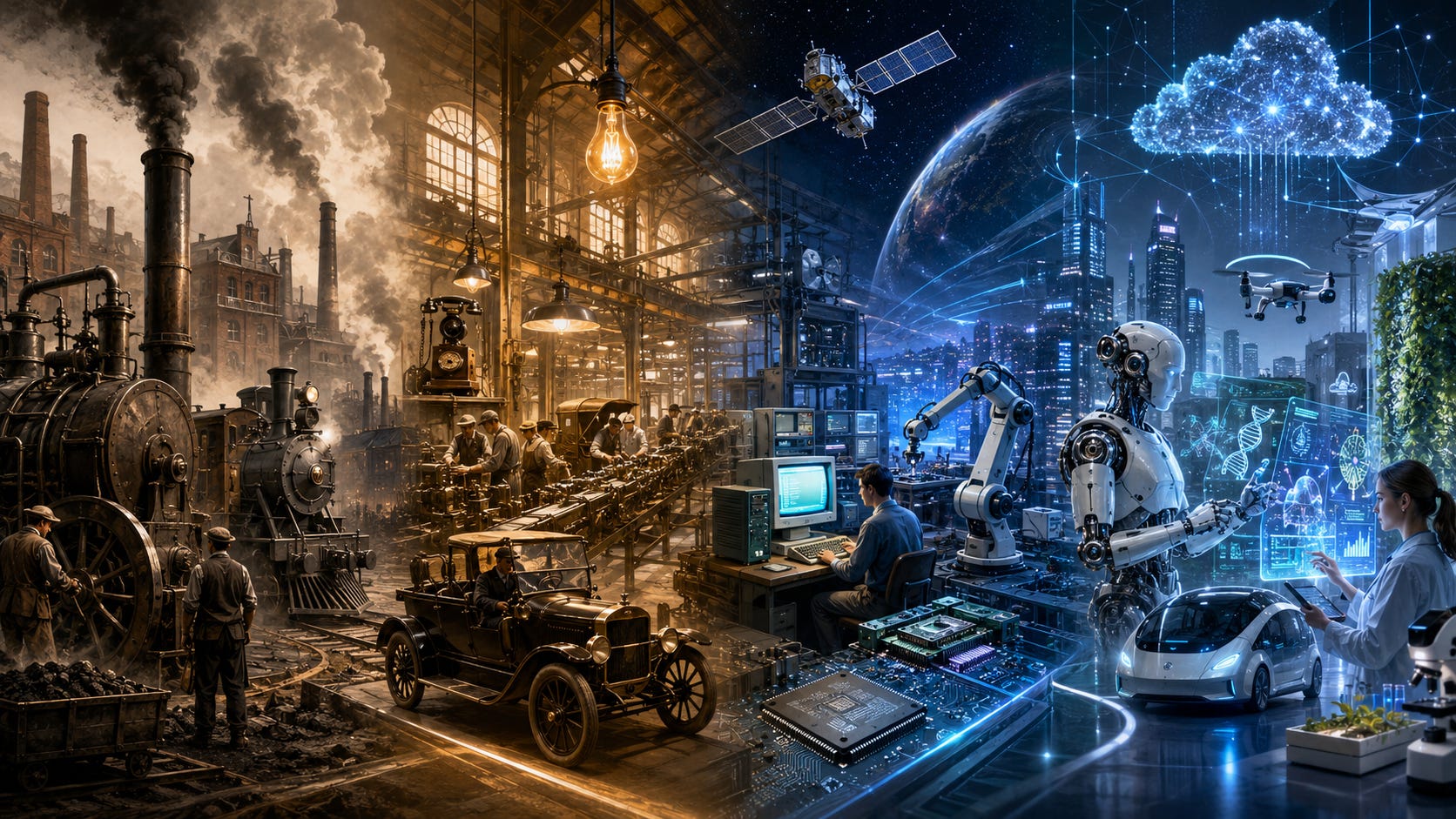
In the 1830s and 1840s, the United States had railroads galore, but not a railroad system. Investors laid track at whatever gauge suited them, so the country filled up with islands of laid track — lines whose carriages could run only on their own rails and couple only with their own kind. Within each island, travel was miraculous. Between them, it was still 1810: at every break of gauge, passengers and freight were unloaded, carted across town, and reloaded onto a different company’s cars — transfers that mercilessly ate time and betrayed the locomotive’s promise: that through freight and long-distance travel would be forever transformed.
Circa 1850, the railroad had been invented. The railroad revolution had not yet happened. That gap — between a working machine and a transformed economy — is the subject of this essay, and, in a sense, of my forthcoming book, History’s Most Revolutionary Innovation (Cambridge University Press).
We remember industrial revolutions as parades of inventions: the engine, the dynamo, the chip. But invention turns out to be the cheapest part. What separates a gadget from a revolution is everything that happens afterward — commercialization, standardization, complementary investment — and, at every point where those processes stall, a visible hand that unsticks them. Industrial revolutions are made, not born. This essay explains what they are made of.
What an industrial revolution actually is
Strip away the romance and an industrial revolution is the commercialization and diffusion of a general purpose technology, or GPT — a technology that, unlike the zipper or the ballpoint pen, pervades the whole economy, keeps improving for decades, and spawns complementary innovations in every industry it touches. Steam was one; electricity and the internal combustion engine were the second wave; the microprocessor was the third. Each revolution was really a cluster — steam arrived with advanced metallurgy and mechanized spinning, electricity with synthetic chemicals, the microchip with software and telecommunications — but in each case one technology supplied the grammar the others spoke.
And in each case the revolution was as much the birth of supply chains as of machines. The railroad was an elaborate symphony of high-pressure engines, precision machine parts, and improved metallurgy for rail casting, all evolving simultaneously — and to bring those components into profitable relationship with one another, entirely new supply chains had to blossom. What gets commercialized in an industrial revolution is never just the invention; it is the web of intermediate goods, specialized suppliers, and contractual relationships that turns the invention into something you can buy.
For any candidate revolution, this essay asks three questions that appear in my forthcoming book. What is the core GPT, and what complementary technologies had to coevolve around it? What had to standardize — which interfaces, components, protocols, and measurements — before diffusion could accelerate? And what investments in infrastructure, skills, organization, and law were required to convert a working prototype into broad, durable productivity gains? Those three levers — coevolution, standardization, complementary investment — decide whether a technology transforms an economy or remains a frontier demo that struggles to scale.
Why the default is stagnation
The questions matter because the default outcome is stagnation, not revolution. Incumbent technologies fight back: wooden sailing ships and windmills kept improving for decades after steam arrived, staying competitive far longer than the textbooks suggest. And incumbency is often rational. American factories clung to the “group drive” — a single steam engine turning a forest of shafts and belts — for a generation after electric motors were plainly superior, because exploiting the motor’s real advantage meant physically redesigning the factory around it. Workers behave the same way: if most employers still run the old system, it is sensible to train for yesterday’s tools. A superior technology can languish indefinitely when switching costs are high, complements are missing, and everyone is waiting for everyone else to move first.
The organizational half of every diffusion story
Standardization, moreover, is necessary but not sufficient, because the second half of every diffusion story happens inside organizations. A GPT pays off only when firms rebuild themselves around it. Bessemer’s converters could mass-produce steel from the 1860s, yet early adopters kept botching the chemistry — controlling oxygen and impurities demanded expertise most mills lacked — and diffusion required organizational learning: standardized furnace designs, two-stage melting processes that reorganized the entire plant floor, heavy investment in training, and roaming technicians from Bessemer’s own licensing operation to teach clients the metallurgy and calibrate their machinery. Economists call what those mills were accumulating intangible capital — new processes, new skills, new structures — and it obeys a stubborn sequence: firms first use a new technology to substitute for the old, an electric motor bolted down where the steam engine sat, and only later reimagine the workflow around it. The gains live almost entirely in the reimagining.
The productivity paradox is a feature, not a bug
This is also why every GPT so far has produced a productivity paradox on arrival. Early adoption is expensive: firms divert resources from producing to learning, reorganizing, and retraining, so measured productivity stalls or even dips just as the hype peaks. Then, once standards congeal and organizations finish rewiring themselves, the gains arrive in a rush. American labor productivity crawled at about 1.4 percent a year from 1970 to 1994 — computers everywhere except in the statistics — then surged past 2 percent from 1994 to 2004 once firms had rebuilt their operations around the technology they had purchased two decades before. The paradox is not evidence that a technology has failed. It is what the middle of an S-curve feels like from the inside.
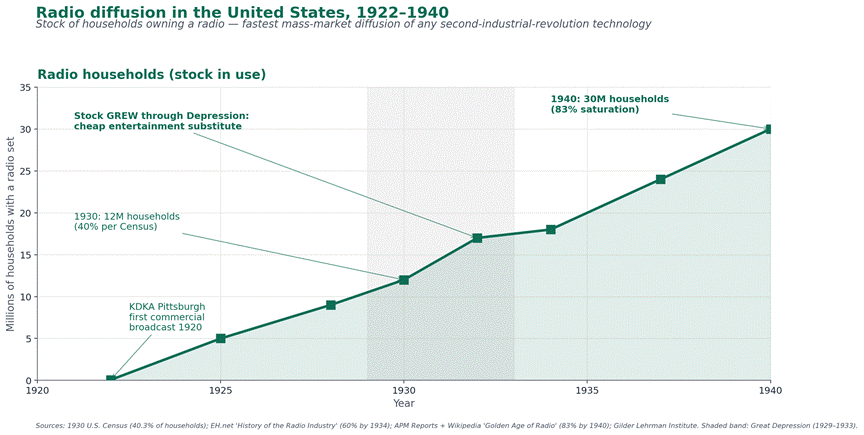
Radio households, 1920–1940: the fastest mass-market take-off in history — from zero to 83 percent of American homes in two decades, accelerating through the Depression because one purchase bought a free stream of entertainment. Author’s figure.
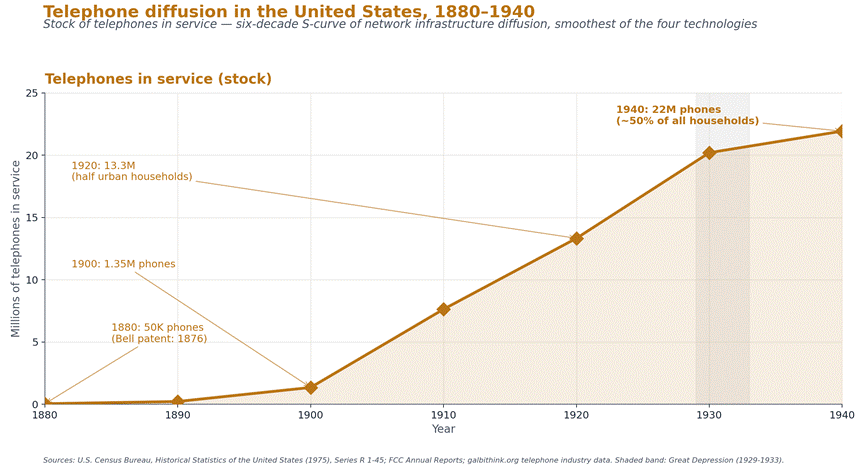
Telephones in service, 1880–1940: roughly six decades from Bell’s patent to broad household penetration — note the Depression dip. Networks that need per-node infrastructure — wires, switches, operators, city by city — diffuse on a slower clock than broadcast. Author’s figure.
Four revolutions, one grammar
First: steam
The First Industrial Revolution was about solving mundane problems: draining mines, moving coal, converting heat into motion inside a factory. Newcomen’s atmospheric engine of 1712 pumped water from flooding mineshafts; Watt’s refinements made the engine efficient enough to leave the pithead. What followed was a virtuous cycle: steam engines drained the mines, making coal cheaper; cheaper coal made steam affordable for everyone else. Freed from the geography of rivers, textile mills moved into cities and ran day and night; railroads, born as coal carts on wooden rails, stitched fragmented local markets into national ones. And diffusion accelerated only as designs standardized — the self-acting spinning mule reached small mills once it no longer required a resident mechanic to keep custom machinery alive, and the railroads became a network only as the gauges finally converged.
Second: electricity, engines, and chemistry
The Second Industrial Revolution — roughly 1870 to the 1930s — ran on electricity, the internal combustion engine, and industrial chemistry. Its signature wasn’t any single machine but the reorganization of production around them. Factories abandoned the central line shaft for unit-driven machines plugged into sockets — but only after motors, voltages, and transmission standardized, and after the war between direct and alternating current settled in AC’s favor.
The payoff was Fordism: interchangeable parts on moving assembly lines, churning out goods at prices that fell as fast as volumes rose. Between 1909 and 1924 the Model T barely changed, yet relentless process innovation cut its price from roughly $950 to $290. Managing production at that scale demanded an organizational invention as consequential as the technical ones — the vertically integrated, multidivisional corporation Alfred Chandler chronicled, with General Electric building an entire ecosystem from the dynamo to the toaster and running a corporate R&D lab to feed it. The era’s complementary investment in people was the high school movement, which supplied the literate, numerate workforce the new factories and offices required.
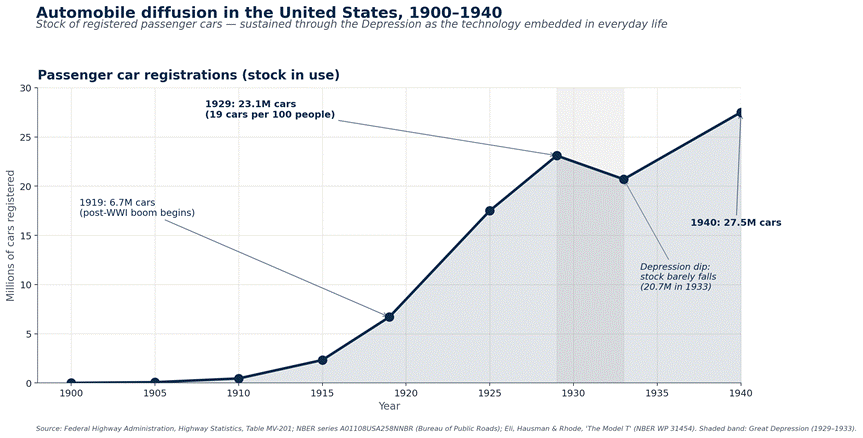
Registered passenger cars in the United States: 19 per 100 people by 1929. Annual production collapsed during the Depression, but the installed stock barely flinched — it is diffusion, not the production line, that transforms a country. Author’s figure.
Third: the microchip
The Third Industrial Revolution began, characteristically, with a bottleneck. Bell Labs invented the transistor in 1947; Texas Instruments put it into commercial silicon in 1954, with the military as its indispensable first customer — and then complex systems hit the “tyranny of numbers”: a missile guidance computer needed thousands of components hand-soldered together, and one bad joint among thousands ruined the machine. The integrated circuit solved the problem by printing transistors and their connections onto a single silicon substrate, and the planar process turned that trick into mass production. Its triumph arrived in 1971 with Intel’s 4004 — a programmable computer on a chip — and Moore’s Law did the rest, doubling transistor counts every couple of years for five decades.
But the industry transformed the economy only after its own standardization phase: the x86 instruction set and the Wintel stack decoupled hardware from software, so a program written once ran on millions of machines; TCP/IP, HTML, and HTTP did the same for networks.
The Third Revolution also produced an institutional innovation to rank with the M-form corporation: the venture-backed startup, seeded by the Fairchild diaspora, which industrialized the financing of long-shot commercialization.
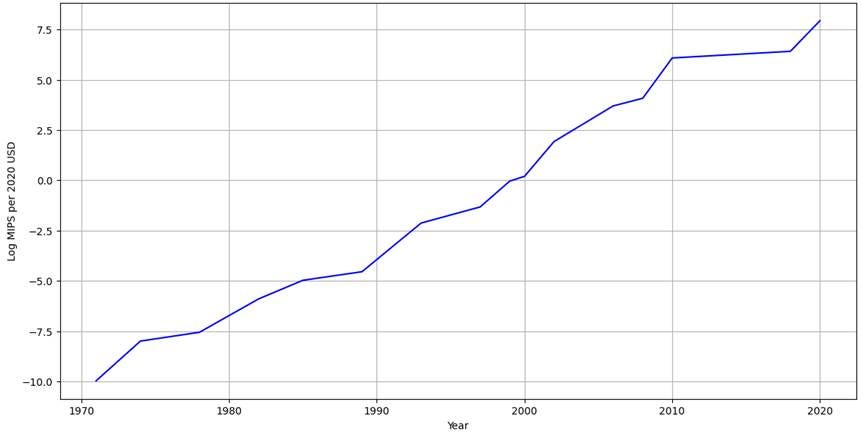
Moore’s Law in economic terms: processor performance per inflation-adjusted dollar, 1971–2020, log scale. Every dollar bought orders of magnitude more computation, decade after decade. From the book’s online appendix, Figure S1.1.
Fourth: artificial intelligence
And the fourth? AI is not one invention but a bundle of complementary capabilities — language, perception, prediction, planning — riding scaling laws that play the role Moore’s Law played for silicon. The training compute behind frontier systems doubled roughly every six months after 2010, and the cost of a frontier training run climbed from an estimated $5 million for GPT-3 to reportedly more than $100 million for GPT-4 — which is why the center of gravity shifted from university laboratories, which could compete when state-of-the-art meant modest compute, to the handful of corporate labs that can field billion-dollar clusters. Training a frontier model is not a software project; it is an industrial undertaking, and it looks like one from the road. Behind it stretches one of the most vertically disintegrated and globally specialized supply chains ever assembled — architecture licensors, fabless designers, a single Dutch lithography firm, fabrication concentrated in Taiwanese foundries, hyperscaler clouds, model labs, and an application layer on top — every interface held together by the patents, licenses, and standards whose origins the next section traces.
In History’s Most Revolutionary Innovation I ask how one would know an industrial revolution was underway without the benefit of hindsight, and the early 2020s pass every test. Intensive capital buildout: just as coal pits, railway hubs, and generating stations swelled across the landscape in every prior installation phase, data centers are doing so now. Exponential adoption: Waymo’s robotaxis took until late 2023 to log their first million cumulative paid trips, quintupled that by the end of 2024, and passed twenty million by the end of 2025 — the classic knee of an S-curve. Exponential performance: on METR’s task-horizon metric — the length of task a frontier agent can complete autonomously half the time — capability has doubled roughly every seven months since 2019, a cadence faster than Moore’s. And multiple simultaneous applications: diagnostic imaging and treatment planning in medicine, predictive maintenance on factory floors, coding copilots, browser agents, discoveries of new protein structures, ten-day weather forecasts generated in under a minute.
Locate all this on the industrial revolution lifecycle, though, and something interesting appears: the fourth one is already deep in its standardization phase, and the first wave has moved with remarkable speed — a story I tell at length in the book. Common model formats began dissolving vendor lock-in at the foundation; shared benchmarks became the era’s consumer-protection standard; the “AI factory floor” of training and deployment pipelines standardized around common orchestration tools. Connecting models to the world, once a matter of bespoke glue code for every database and application, collapsed onto the Model Context Protocol — write once, connect to any compliant system. Even governance began to standardize: NIST’s AI Risk Management Framework and the EU AI Act’s presumption of conformity began turning compliance from a bespoke legal battle into a standardized engineering task. And in late 2025 came what may prove this era’s TCP/IP moment: rival laboratories concluded that open infrastructure beats proprietary control for agents, and OpenAI, Anthropic, and Block co-founded the Agentic AI Foundation — donating MCP, the AGENTS.md format, and an open agent framework to neutral stewardship — because agents that must discover one another’s capabilities, issue task orders, and verify completion need a shared messaging layer, a SWIFT for digital workers, that no single firm can impose.
What remains genuinely fluid is the deeper wave: evaluation regimes rigorous enough for hospitals and banks, liability rules for autonomous action, and the trust conventions of agent-to-agent commerce. Standardization, as this history keeps teaching, is never purely technical; it is always also political.
The binding constraint, then, is the other half of the recipe: organizational adaptation. Most firms remain in what the book calls pilot purgatory — using AI to substitute rather than transform, writing the same email faster instead of redesigning the workflow that generates the email — which is precisely the first wave of factory electrification replayed: motors bolted down where the steam engines sat, the architecture of production untouched, the gains unrealized.
Education is the cleanest example of what the collision looks like. Bloom’s famous “2 Sigma” finding — that one-on-one tutoring lifts students two standard deviations above the conventional classroom — has haunted educational psychology for forty years because no society could afford a tutor per child. AI promises exactly that for the price of electricity, yet rollouts remain stuck in pilots, snagged on incompatible data systems, privacy law, teacher skepticism, and unequal infrastructure: a technology waiting on organizations.
Even the driverless car, the poster child of exponential adoption, took fifteen years of organizational and institutional grind — fleets, insurance, maintenance networks, city-by-city regulatory settlements — to get from the DARPA Grand Challenge to a commercial service. Anyone frustrated that AI hasn’t yet shown up in the productivity statistics is describing the 1980s of every previous revolution.
The state as midwife
Here is the part the invention-parade version of history leaves out. At every stage of every one of these transformations, markets alone under-delivered — predictably, for reasons economists understand well — and the state stepped in, not as a planner, but as a midwife to a birth that was otherwise going badly.
Why markets under-deliver
Start with the deepest failure. Ideas are public goods: non-rival and hard to fence. William Nordhaus estimates that innovators capture only about 2.2 percent of the total surplus their innovations create and estimates of the social return to R&D run to 60 percent or more — several times the private return. Faced with such a meager slice, rational firms systematically underinvest in exactly the research that launches GPTs, leaving trillion-dollar bills on the sidewalk because no one can privatize the pickup. Standardization poses a second failure: a coordination trap. Everyone gains if the industry converges on one design, but no firm dares invest in a standard that might strand it — so markets can sit in fragmented, inferior equilibria indefinitely. The gauge wars were exactly that trap, and no railroad could escape it alone.
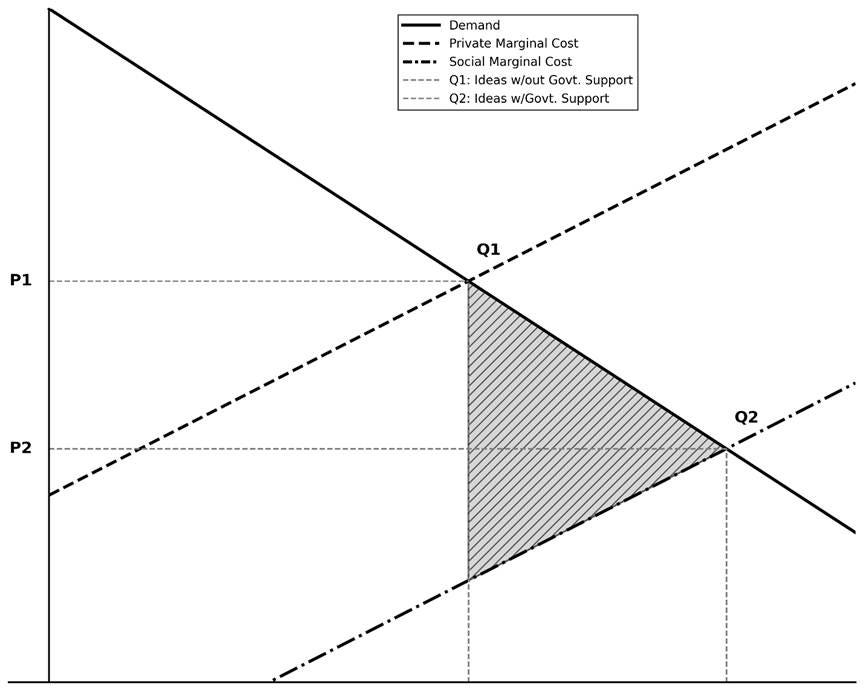
The underprovision of ideas: the wedge between private and social marginal cost is the spillover firms cannot capture, and the hatched triangle is the deadweight loss a well-designed subsidy eliminates. From the book’s online appendix, Figure S1.2.
Against these failures, governments have historically deployed a five-part toolkit.
Fund the science
First, they fund the science. Britain chartered the Royal Society in 1660 and built the culture of useful knowledge that preceded the first revolution; the American century ran the model at scale. The Army bankrolled ENIAC; ARPA funded the packet-switching research that became the internet; and federal science agencies — NSF, ONR, NIH — together with defense procurement built the ecosystem around solid-state physics, semiconductors, and computing, in which private laboratories like Bell Labs did much of the inventing while government supplied both the underlying science and the first markets.
Patents are supply-chain infrastructure
Second, they build property rights for ideas — and here it matters to see what patents actually do, because the textbook story sells them short. A patent converts a public good into something like a club good — excludable by law, still non-rival in fact — and in doing so creates a market for ideas: inventions that can be licensed, divided, collateralized, and sold.
But the deeper function is that patents are the legal infrastructure of new supply chains. Exclusion and disclosure work together to let strangers find each other: because the invention is published and protected, financiers, assemblers, distributors, and marketers can seek out the inventor and contract with her at arm’s length, each specializing in its comparative advantage — the inventor in inventing, everyone else in what they do cheapest. The licensing contract, underpinned by a legally enforceable patent, is what helps transfer the tacit know-how a technology needs to travel — the blueprints, the machinery, the onsite training — and, as licensees improve what they license, the knowledge flows back upstream.
The Cohen-Boyer patent on recombinant DNA shows the mechanism in miniature. Stanford and the University of California licensed the foundational gene-splicing technique broadly and non-exclusively; hundreds of startups and pharmaceutical firms built the modern biotechnology industry on it — and that horizontal diffusion called into existence a vertical one: a whole new market of specialized suppliers of enzymes, reagents, and laboratory equipment. One patent, licensed well, summoned a supply chain.
Crucially, the marketplace where such deals happen is itself grafted atop public infrastructure: examiners, registries, and specialized tribunals — above all the Court of Appeals for the Federal Circuit, created in 1982, which helped make patent rights predictable enough to contract on. Therefore, the government does not merely protect ideas; it bankrolls the market in which they trade. And the payoff came due in the late Third Revolution, when strong, tradable IP catalyzed the vertical disintegration of the electronics industry — fabless designers like Qualcomm and ARM specializing in high-value chip design while foundries an ocean away did the fabrication, an arrangement thinkable only because a design is an enforceable, licensable asset.
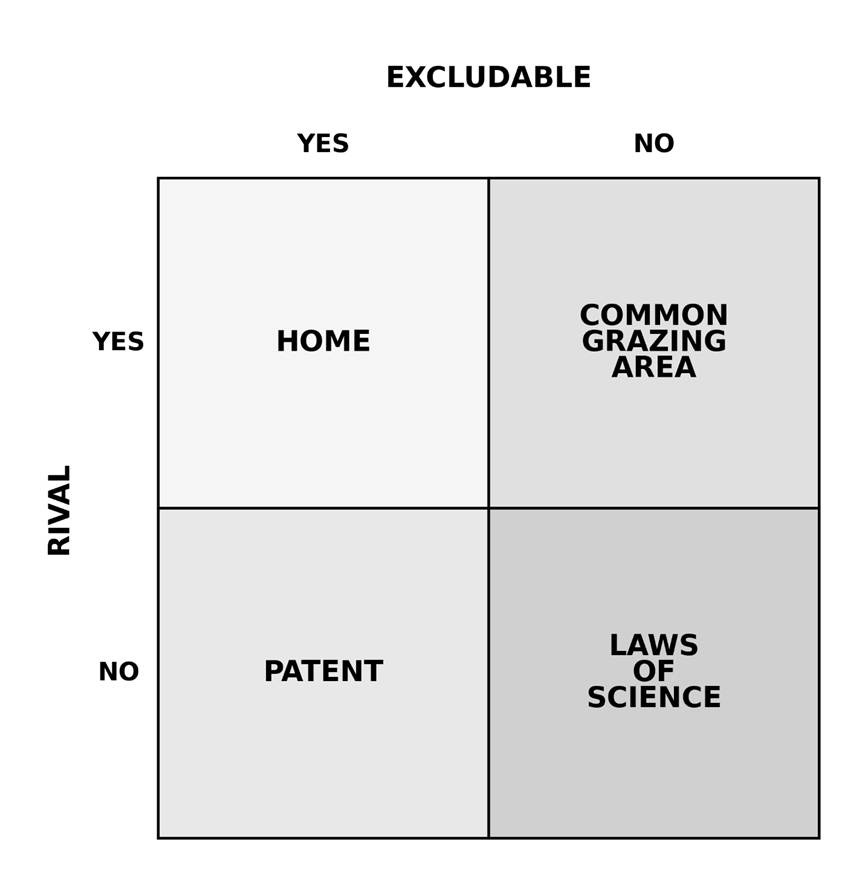
How intellectual property rights convert non-rival knowledge from a public good into something like a club good — excludable by law, non-rival in fact. From the book’s online appendix, Figure S1.3.
Finance the gap, break the deadlock
The state provides other support structures too.
It sometimes directly finances the valley of death between prototype and product. Parliament’s Board of Longitude paid John Harrison more than £23,000 across decades to perfect the marine chronometer that private investors dismissed; two and a half centuries later, the SBIR program wrote early checks to a struggling San Diego startup called Qualcomm.
It may also help break coordination deadlocks — sometimes as the customer of first resort (the military’s bulk transistor purchases and the Minuteman contracts gave the young chip industry guaranteed demand and forced a design to converge), sometimes by seeding an installed base (the Defense Department’s 1983 TCP/IP cutover and the NSF’s backbone gave the protocol running code and users that later mandates for rival OSI architectures could not dislodge), sometimes as a convener and measurement authority (NIST and the legal scaffolding around private standards bodies like IEEE and 3GPP, which produced Wi-Fi and 4G under FRAND licensing commitments), and sometimes by consortium — SEMATECH pooled fourteen rival chipmakers with federal money and, alongside trade policy and corporate restructuring, helped reverse a decade of market-share losses to Japan.
Build the complements
It also goes without saying that the state helps build complements to the technologies that power industrial revolutions in the form of basic infrastructure and educating people. Canals and harbors in the nineteenth century, the TVA’s rural electrification that crowded in decades of private industrial investment, the interstate highways, the internet backbone. And, above all, education: the Morrill land-grant colleges trained the engineers of the industrial age, the GI Bill and the Higher Education Act stocked the third revolution with graduates, and the research universities they built anchored every innovation cluster from Route 128 to Silicon Valley. Goldin and Katz called American history a race between education and technology; the state was how education kept pace.
Referee the split
Finally, there is one more role, subtler than the rest. Even when everyone agrees a common standard is worth having, the parties fight over which standard — because the choice decides who captures the surplus. Game theorists call this a Battle of the Sexes, and it is endemic to technology: upstream patent holders and downstream implementers both want interoperable smartphones, but they want opposite royalty structures. Left alone, the strong impose rules that favor themselves, or cooperation collapses. The job here — shared among public law, antitrust policy, courts, and the private standards bodies that operate in their shadow — is not to pick the winner but to design the game: revenue-sharing formulas, supermajority voting rules, dispute forums, terms like FRAND, so that even the weaker party can commit to cooperating. Done well, this converts zero-sum brawls into positive-sum settlements. It is the least glamorous thing a government does for innovation, and among the most important.
Not a brief for dirigisme
None of this condones dirigisme. The record I’ve sketched is not one of states picking winners or planning economies; where they tried, they mostly failed. It is a record of states solving specific, well-defined market failures — public goods, coordination traps, missing credit, distributional standoffs — that private actors demonstrably could not solve alone. That is the version of industrial policy the American postwar system institutionalized, and the version my book argues built the legal and financial scaffolding on which the AI economy now stands.
The fourth revolution’s to-do list
Run the checklist against the still in progress and still in doubt AI Revolution and a familiar agenda, albeit with new characteristics, emerges.
The science: reliability, reasoning, alignment, and evaluation are open problems whose returns no single firm can fully capture — exactly the class of research the public purse exists to fund.
The standards: the first wave — model formats, benchmarks, MCP, the Agentic AI Foundation — congealed fast, but the deeper wave of evaluation regimes, liability rules, data rights, and agent-commerce trust is today’s ungauged track, and whether it congeals through open consensus bodies or proprietary lock-in will shape the industry’s structure for a generation.
The infrastructure: the buildout this time is measured in gigawatts, and permitting an interconnection queue is the modern equivalent of granting a railroad right-of-way.
The organizations: firms escape pilot purgatory only by accumulating intangible capital — redesigned workflows, reskilled people, new structures — and that accumulation, not model capability, now sets the pace of the revolution.
The people: every previous revolution paid off only after a generation-scale investment in complementary skills, and there is no reason to believe the fourth has repealed that law.
The machines, as ever, are the easy part. In the 1840s the locomotives worked beautifully; what America lacked was a gauge. The AI economy is laying its track right now — its protocols, its standards, its institutions, its people. Whether this becomes the fourth industrial revolution or a long archipelago of impressive, incompatible islands depends far less on the next model release than on whether, this time too, we do the unglamorous work of making the gauges match.