
Creative Destruction Meets the Unitary Executive
Independent agencies were good for innovation and what comes next may not be

On June 29th, 2026, in Trump v. Slaughter, the Supreme Court held that President Trump may dismiss a commissioner of the Federal Trade Commission without cause — a ruling that directly ends the FTC’s old removal protection and puts similar protections at serious risk for a long roster of bodies that have operated at arm’s length from the White House for generations. All bets are off at the National Labor Relations Board, the Federal Communications Commission, the Securities and Exchange Commission, the Nuclear Regulatory Commission, the Consumer Product Safety Commission, and more.
A strong version of the unitary executive theory — an idea that took hold among young Justice Department lawyers in the early 1980s — is therefore now the law of the land: Humphrey’s Executor, the 1935 precedent that let Congress insulate these agencies from presidential whim, has been swept aside — “if anything more is left of Humphrey’s, we overrule it,” wrote Chief Justice Roberts for the 6–3 majority, over a dissent Justice Sotomayor read aloud from the bench. The Federal Reserve, on idiosyncratic historical grounds, appears to remain outside the rule. For now, at least — the boundaries of that exception are anything but clear…
What does this decision do to the machinery that actually produces American technological dynamism?
Innovation is a long-horizon bet. Firms sink enormous, irreversible investments — fabrication plants, data centers, R&D pipelines, spectrum licenses, clinical trials — on the assumption that the regulatory treatment of those bets won’t swing wildly with the political winds. The whole purpose of insulated, professionalized agencies was to make regulation legible and stable enough to invest against.
In my forthcoming book, History’s Most Revolutionary Innovation (Cambridge University Press), I argue that the engine of American innovation over the last half-century was not “neoliberalism,” and not deregulation for deregulation’s sake — paradigms that, I contend, never really governed the United States. Instead, it was an exceptionally American experiment in policymaking that I christened the Creative Destruction Paradigm: an evidence-based, cost–benefit regulatory order, assembled incrementally from Carter through Obama, that lowered transaction costs, solved coordination failures, and managed distributional conflict in the service of technological change.
Neither laissez-faire nor state-directed industrial policy, the Creative Destruction Paradigm was a rule-bound device for underwriting American innovation. It depended on the shared expectation that the rules of the road are durable, evidence-driven, and applied predictably rather than opportunistically.
Within this context, Humphrey’s Executor mattered not because independence is sacred, but because insulating agency leadership helped preserve space for professional staff to run long-range studies, gather data, and engage in fact-finding without every technical conclusion being immediately subordinated to presidential preference. What mattered instead was neutral competence.
On top of that insulation sat procedural discipline: the Administrative Procedure Act’s notice-and-comment regime and its “arbitrary and capricious” standard; the requirement that agencies justify decisions with a reasoned explanation grounded in an evidentiary record; and, for executive agencies, the centralized cost–benefit review system that ran from Reagan’s Executive Order 12291 through Clinton’s 12866 at the Office of Information and Regulatory Affairs. Independent agencies were never fully inside that OIRA system, but they operated within the same broader technocratic culture of record-building, expertise, and judicial review.
For example, after the Telecommunications Act of 1996, it was the FCC — through a methodical series of market-based spectrum auctions — that allocated wireless frequencies to the carriers best positioned to use them, seeding the mobile networks on which the smartphone economy, and then the data economy, would run. That same predictability let a fabless upstart called Qualcomm bet its future on Code Division Multiple Access shows the same logic from another angle: years before the 1996 Act, the fabless upstart staked its future on a technically risky spread-spectrum standard that would become foundational to modern wireless — a long-horizon wager on spectrum policy, standards, and patents that only a predictable rule-bound ecosystem could reward. And once antitrust had settled into an evidence-based consumer-welfare standard that tolerated scale when the data showed consumers gained — and once Section 230 shielded platforms from ruinous liability for what their users posted — companies like Google, Facebook, and Amazon could build the multi-sided markets that turned billions of users into gushers of behavioral data. That flywheel proved a godsend for the AI developers who drew on it to train large language models like ChatGPT.
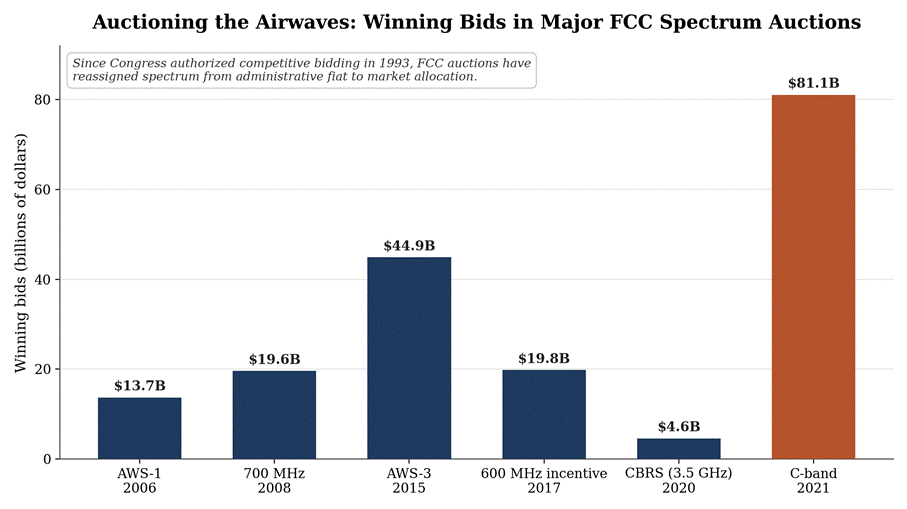
Figure 1. Auctioning the airwaves. Winning bids in six major FCC spectrum auctions, from AWS-1 in 2006 ($13.7 billion) to the record C-band auction of 2020–21 ($81.1 billion). Since Congress authorized competitive bidding in 1993, the auction program has replaced allocation by administrative fiat with allocation by market — assigning spectrum to the carriers that valued it most and, in the process, capitalizing the networks on which the mobile and data economies run. It is a quiet, technocratic program of exactly the kind that agency insulation made credible. Source: Federal Communications Commission auction results as reported at auction close (AWS-1: Auction 66; 700 MHz: Auction 73; AWS-3: Auction 97; 600 MHz broadcast incentive: Auctions 1001/1002; CBRS: Auction 105; C-band: Auction 107).
Or consider intellectual property, where the machinery of American innovation runs through a lattice of expert institutions — the USPTO inside the Department of Commerce, and independent or quasi-independent bodies like the FTC and the International Trade Commission. The IP revolution of the 1980s and 1990s was not an ideological project; it was built claim by claim on evidentiary records. The Bayh–Dole Act of 1980 passed because its sponsors marshaled data showing that fewer than five percent of some 28,000 government-held patents had ever been licensed, and argued that promising federally funded inventions — including biomedical discoveries — were left undeveloped because no firm would finance costly clinical trials without reliable exclusive rights. Giving universities clear title to commercialize federally funded research created a repeatable path from lab bench to market — the path that carried the Cohen–Boyer recombinant-DNA breakthrough out of Stanford into broad commercial licensing, helping seed the biotechnology industry, from firms like Genentech to products like recombinant insulin and new cancer therapies.
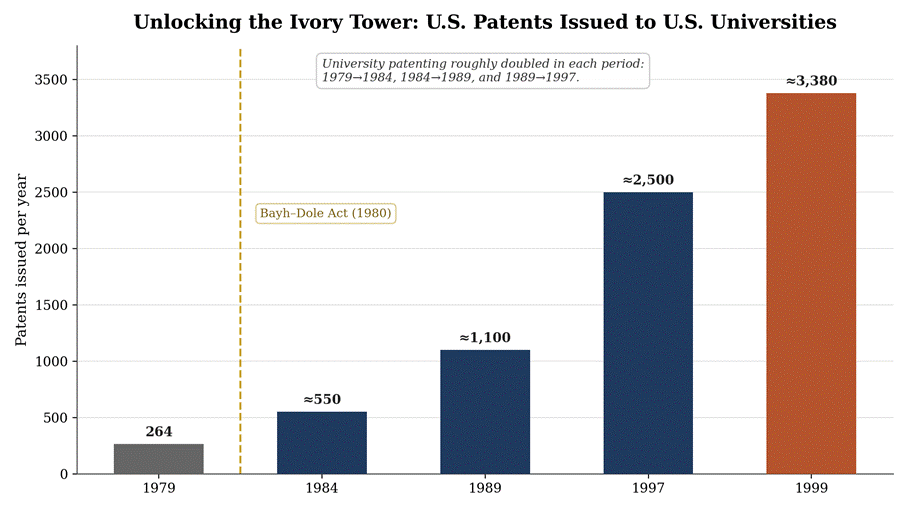
Figure 2. Unlocking the ivory tower. Annual U.S. patents issued to American universities, before and after Bayh–Dole. Universities received just 264 patents in 1979; patenting then roughly doubled between 1979 and 1984, doubled again by 1989, and doubled yet again by 1997, reaching about 3,380 by 1999 — the takeoff that turned research campuses into commercialization engines. Values after 1979 are approximate, reflecting the successive doublings documented in the source. Source: David C. Mowery, Richard R. Nelson, Bhaven N. Sampat & Arvids A. Ziedonis, “The Growth of Patenting and Licensing by U.S. Universities,” Research Policy 30(1), 2001; see also Mowery et al., Ivory Tower and Industrial Innovation (Stanford University Press, 2004).
The USPTO worked the same way. When software firms pressed for patent protection in the early 1990s, the agency did not simply take a side. It held public hearings in 1994, solicited formal comments in 1995, and weighed evidence presented in that record that software development had become a capital-intensive industrial process — with average project budgets surging past $10 million — before updating its examination guidelines in 1996.
The result was a patent system that could underwrite the software and semiconductor booms: total applications at the USPTO nearly tripled between 1980 and 2000, from roughly 112,000 to over 315,000.
Meanwhile, the nonpartisan ITC supplied the technical analyses — on tariffs, on import competition, on the economics of trade liberalization — that let successive administrations of both parties open markets for American technology on the strength of quantified evidence rather than lobbying muscle. Its studies informed major trade-policy debates from the Tokyo Round of GATT to NAFTA.
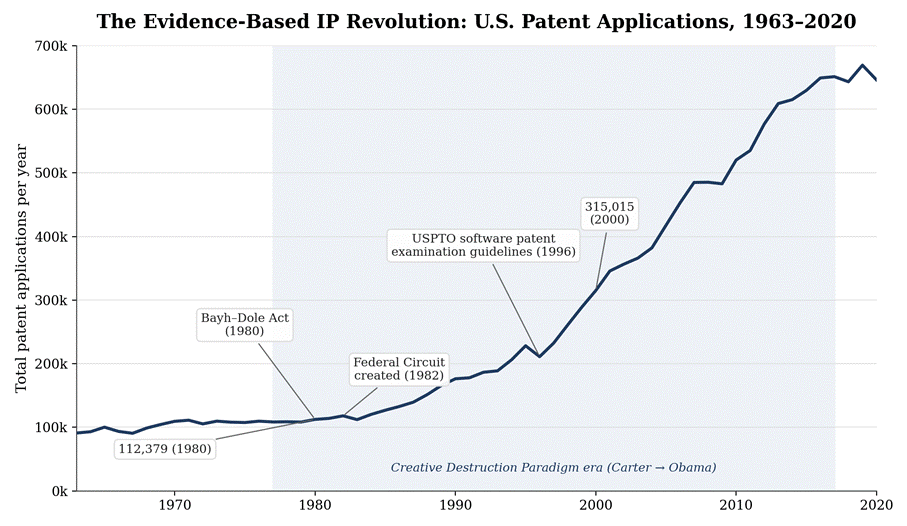
Figure 3. The evidence-based IP revolution. Total applications filed at the U.S. Patent and Trademark Office each year, 1963–2020. Applications were essentially flat for two decades — about 108,000 in 1979 — then began a forty-year climb after the reforms of the early CDP era (shaded): the Bayh–Dole Act (1980), the creation of the Court of Appeals for the Federal Circuit (1982), and, following public hearings and formal comment, the USPTO’s 1996 software examination guidelines. Applications nearly tripled between 1980 (112,379) and 2000 (315,015) and kept climbing, exceeding 600,000 a year by the 2010s. Source: U.S. Patent and Trademark Office, Patent Technology Monitoring Team, U.S. Patent Statistics Chart, Calendar Years 1963–2020.
We already know what happens when that machinery gets politicized, because we have run the experiment on a small scale. In the narrow but economically vital domain of standard-essential patents — the technologies at the heart of 4G, 5G, and Wi-Fi — policy has lurched with each administration: pro-patentholder guidance in 2019, withdrawal of that guidance by the Biden administration in 2022, and then a renewed move toward stronger patentholder remedies under the second Trump administration, which deployed the USPTO to file statements of interest in private litigation. Each swing shifted substantial licensing leverage between patent holders like Qualcomm and implementers like Apple. Trump v. Slaughter threatens to scale it to the entire regulatory state.
Notice what the lurching does. Distributional fights are inevitable in a modern economy — patent holders and implementers will always battle over how to split the surplus a technology standard creates, and each side will always lobby to weaken the other's rights. The Creative Destruction Paradigm's quiet achievement was to keep those fights inside a stable, evidence-based framework, so that arguing over shares of the pie never stopped the pie from growing. Once the rules themselves swing with each election, the calculus changes: firms rationally redirect resources from engineering to lobbying, from R&D to litigation, from contributing technologies to open standards toward hedging against the next reversal. The conflict over who gets what bleeds into how much there is to get at all. That is the deeper cost of politicized regulation — it converts positive-sum games into negative-sum scrambles.
To be sure, serious people defend the ruling as a restoration of democratic accountability, and the old administrative state did carry real pathologies — capture, overreach, the sheltering of incumbents — failures I document at length in my book. But accountability to the president is not the same thing as accountability to evidence.
The danger now is not that we get less regulation, or more. It is that we get regulation bent to political ends — an FCC leaned on to punish a broadcaster the president dislikes; an FTC or NLRB deployed to reward friendly firms and harass disfavored ones; the technical judgments of the NRC or CPSC overridden for reasons that have nothing to do with the underlying evidence. Trading rule-bound expertise for presidential discretion doesn’t lighten the regulatory hand so much as politicize it.
None of this is destiny. Litigation under existing statutes remains a potent accountability channel; states continue to fill federal vacuums; private ordering — standards bodies, audits, insurance markets — can backstop where public capacity falters. But the Creative Destruction Paradigm’s institutional foundations just got conspicuously thinner, and the burden now shifts to whoever holds the presidency to wield the newly concentrated power with the restraint that evidence-based governance used to enforce automatically. This seems unlikely.